

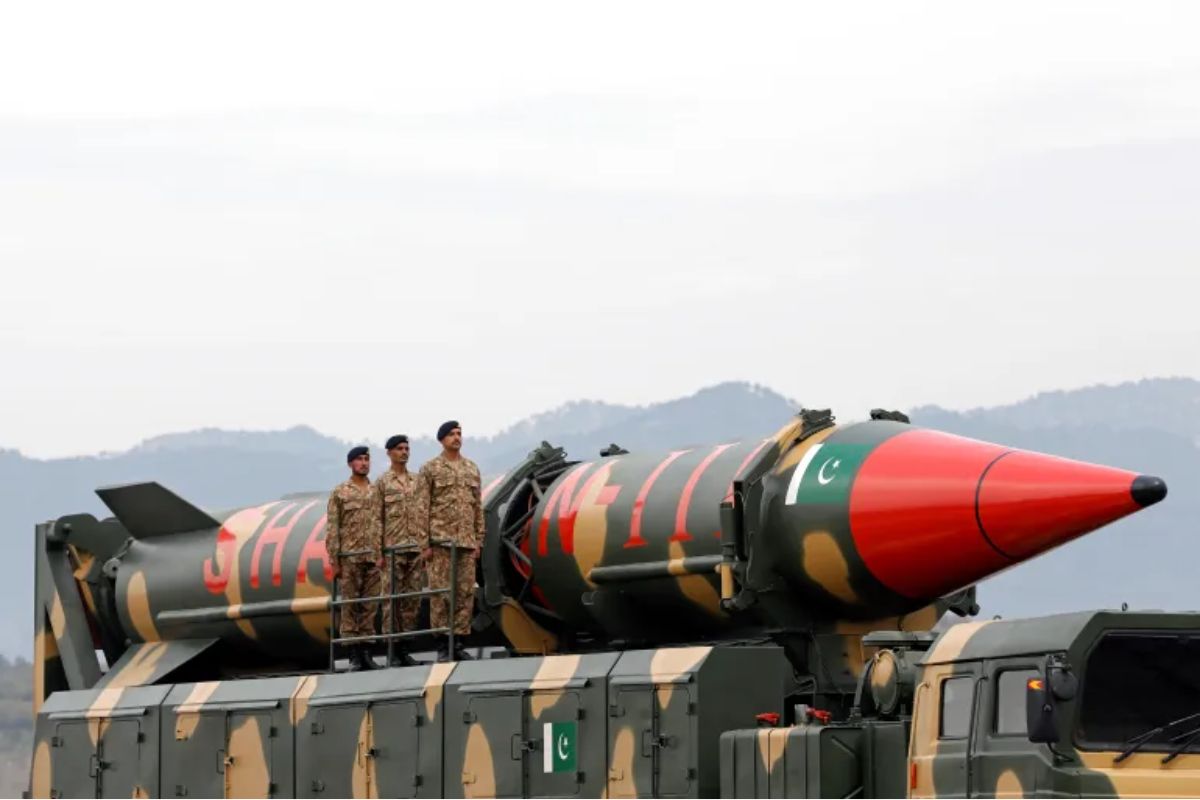
Pakistani Missiles have recently set the stage for escalating tensions, prompting the United States to impose sanctions on Pakistan in a move that has startled onlookers across the globe. The sudden jolt of punitive measures has left many wondering why the US, an ocean away from Pakistan, would place such heavy scrutiny on a decades-old ally—especially given that Pakistani missiles remain limited in their ability to reach American shores 12,000 kilometres away.
The official rationale centres on the claim that Islamabad is pursuing long-range ballistic missile development with potential nuclear capabilities. While India has long been within Pakistan’s missile range, it remains clear that something else—outside the South Asian theatre—has captured Washington’s attention. Many analysts argue the actual trigger for these sanctions goes well beyond the India-Pakistan rivalry.
In the waning weeks of President Joe Biden’s administration, the US government announced sweeping restrictions on Pakistan’s state-owned National Development Complex (NDC) and three Karachi-based associated entities for advancing the Shaheen ballistic missile program.
The timing is peculiar: for decades, Pakistan was designated as a “major non-NATO ally” of the United States, especially after the Cold War ended and the so-called “War on Terror” began in the wake of 9/11. Yet the US has now levied strict measures against Islamabad for what it perceives as “an emerging threat.” This scenario raises critical questions about the interplay between domestic politics, shifting geopolitical alignments, and the broader American security calculus.
Pakistan’s foreign ministry denies these accusations, calling them “baseless” and an attempt to derail Pakistan’s legitimate pursuit of regional deterrence. Officials in Islamabad have repeatedly cited India as the primary impetus behind Pakistan’s nuclear and missile capabilities. Still, growing evidence suggests that Washington’s reaction is less about India and far more about concerns beyond the subcontinent. Observers speculate that the real x-factor may well be Israel, a longtime US ally in the Middle East. By some accounts, the US is especially wary of any power in the region—particularly one with alleged ties to militant groups—that could shift the balance of the Middle East power equation.
The sudden imposition of sanctions on Pakistan underscores a broader transformation in US foreign policy. In a post–October 7 world, following the Hamas attack on Israel, Washington has become even more vigilant about protecting its closest allies. This has reignited focus on the Middle East, further fueling concerns about Pakistan’s missile range. Islamabad’s technology, if upgraded, could potentially target areas beyond South Asia. Though no immediate threat to US soil exists, the mere possibility that these missiles could one day reach strategic American partners, including Israel, is raising alarm bells.
Below is an extensive look into the roots of Pakistani Missiles, the Cold War alliances that shaped them, and the international ramifications reverberating in today’s headlines.
The Historical Roots Of Pakistani Missile Development
Pakistan’s missile ambitions can be traced back to the 1980s, a decade marked by Cold War tensions, Soviet intervention in Afghanistan, and shifting alliances in South Asia. While Pakistan cooperated closely with the United States to back anti-Soviet fighters in Afghanistan, it also remained locked in a bitter regional rivalry with India. Western powers largely overlooked Islamabad’s nascent nuclear program during this era—citing realpolitik considerations and a desire to counter Soviet influence.
By the early 1990s, following the Soviet withdrawal from Afghanistan, Pakistan found itself with extensive military hardware, a robust intelligence apparatus, and a newly emerging nuclear capability that the West could no longer ignore. The Pressler Amendment, passed by the US Congress in 1985, mandated sanctions on Pakistan if it was found to be pursuing nuclear weapons. By 1990, the US imposed nuclear-related sanctions on Islamabad, citing clear evidence of nuclear weapons development.
While these sanctions were later modified or lifted at various points—especially after the 9/11 attacks made Pakistan a frontline ally in the “War on Terror”—Pakistan’s missile development continued in parallel. Central to this pursuit was the desire to maintain strategic parity with India, which had launched its missile programs (like Agni and Prithvi). In an attempt to bolster deterrence, Pakistan rolled out the Hatf, Shaheen, and Ghauri series of ballistic missiles, each aimed at delivering either conventional or nuclear payloads. Over time, these missiles have evolved in range, accuracy, and payload capacity.
Cold War Shadows And Alliances
Historically, Pakistan’s alliance with the US dates back to the early Cold War period when it joined CENTO (Central Treaty Organization) and SEATO (Southeast Asia Treaty Organization) as a bulwark against Soviet expansion. In exchange for military and economic assistance from Washington, Pakistan granted the US access to air bases. This arrangement benefited both sides in the immediate decades after World War II.
However, the 1971 war with India—when the US under President Richard Nixon covertly supported Pakistan—served as a watershed moment, revealing the complexities of Washington’s approach to South Asia. Even as the US diplomatically favoured Pakistan, international pressure on Islamabad’s nuclear ambitions intensified. By the late 1970s, Pakistan had made considerable strides in uranium enrichment under the guidance of scientists like Abdul Qadeer Khan, often called the “father of Pakistan’s nuclear bomb.” This nuclear program, in synergy with missile development, made Islamabad a focal point of Western scrutiny.
With the Soviet invasion of Afghanistan in 1979, the US found renewed strategic value in Pakistan, funnelling billions of dollars in aid to support Afghan mujahideen fighters. During this period, Islamabad managed to keep Western condemnation of its nuclear program at bay, mainly because the US and its allies were more concerned with defeating the Soviets.
Why US Is Concerned About Pakistani Missiles?
Despite the historical camaraderie, the US has grown increasingly wary of Pakistani Missiles for several interlocking reasons:
- Nuclear Factor: Pakistan’s missile program is closely tied to its nuclear arsenal, which is believed to include around 170 warheads. According to experts, this number could grow to 200 within the next few years. Such an expansion underscores fears that these warheads could either be used in a regional conflict or, in a worst-case scenario, fall into the hands of extremist elements.
- Unstable Domestic Situation: Pakistan’s political landscape is often marked by periods of instability, military dominance in governance, and the influence of ultraconservative religious factions. For decades, analysts have warned that internal unrest, a fragile economy, or a severe conflict with India could create conditions conducive to nuclear mismanagement or proliferation.
- Potential Threat To Israel: As a close US ally in the Middle East, Israel’s security is of paramount importance to Washington. If Pakistani missiles can extend beyond India and reach regions in West Asia, it raises immediate questions about the balance of power in an area already fraught with tensions. Pakistani officials have occasionally made statements threatening Israel, and while these might be rhetorical or provoked by misinformation, the US sees them as red flags.
- Pakistan’s History With Non-State Actors: From the Taliban to other extremist groups, Pakistan’s security apparatus has been accused of selectively confronting some militant outfits while tacitly allowing others to operate. Washington remains concerned that technology or material from Pakistan’s missile program could leak to non-state actors, further destabilizing an already volatile region.
- Shifting Global Alliances: As international alliances shift—China’s influence grows, Russia seeks new partnerships, and the Middle East experiences upheaval—the US is recalibrating its foreign policy. Pakistan’s deepening ties with China, exemplified by the China-Pakistan Economic Corridor (CPEC), add a new dimension to how Washington views Islamabad.
Pakistani Missiles And The Historical Backdrop
Pakistani Missiles have not evolved in isolation. India’s ballistic missile programs catalyzed Islamabad’s accelerated efforts. In pursuit of a reliable deterrent, Pakistan frequently tested short- and medium-range missiles such as Shaheen, Ghauri, and Babur. Each test garnered significant media attention and condemnation or cautionary notes from Western governments.
Shaheen III, with a range of up to 2,750 kilometres, marks one of Pakistan’s significant leaps in missile technology. Introduced in 2015, Shaheen III can target India’s remote territories, including the Andaman and Nicobar Islands and parts of the Middle East. It is not an intercontinental ballistic missile (ICBM), but it pushes the range threshold far beyond previous Pakistani missiles.
Simultaneously, Islamabad has worked on cruise missiles (like the Babur series) that can evade radar defences, raising further concerns about the first-strike potential and strategic stability in South Asia. The US decision to impose sanctions suggests that policymakers in Washington believe Pakistan is edging closer to developing or acquiring longer-range systems, even if that capability remains aspirational.
Geopolitical Shifts And Concern Over Israel
While Pakistan consistently frames its missile capability as a deterrent against India, the US actions indicate deeper worries. The possibility of Pakistani Missiles being used to threaten Israel—especially in an era of heightened regional tensions—cannot be understated. Over the years, certain Pakistani officials, including a former defence minister, have referenced Israel in veiled or explicit threats, even if these statements were later dismissed as rhetorical or based on misinformation.
Since the October 7 Hamas attacks on Israel, the US has adopted an even more uncompromising posture in defending its ally. This shift includes heightened intelligence sharing and a zero-tolerance policy toward any potential nuclear or missile-related threat to Israel. While Pakistan has not explicitly declared Israel within its crosshairs, the US now seems unwilling to take any chances.
This urgency reflects historical precedents where the US and its NATO allies took preemptive action to deter a nuclear or missile threat. With the Middle East’s significance in the global energy supply, any instability involving nuclear-armed players would reverberate far beyond the region.
The Ongoing Rationale For Sanctions
In early statements, US officials cited “an emerging threat” stemming from Pakistan’s alleged pursuit of long-range ballistic missile technology. Deputy National Security Advisor Jon Finer argued that Islamabad’s behaviour raises “real questions” about its intentions, pointing to a potential capability of targeting areas well outside South Asia, even stretching toward US allies in the Middle East or Europe.
Under an executive order aimed at “proliferators of weapons of mass destruction and their means of delivery,” the sanctions target Pakistan’s National Development Complex and three Karachi-based companies. The immediate effect is freezing any US-based assets and severe restrictions on trade with these entities. While previous sanctions have not permanently crippled Pakistan’s defence sector—often because other countries, such as China, step in—the message remains unequivocal: proceed further, and face more profound international isolation.
Pakistan, for its part, slammed the sanctions as irrational and detrimental to bilateral ties, emphasizing that its missile program is purely defensive. Pakistani Prime Minister Shehbaz Sharif maintained that Pakistan’s nuclear and missile arsenal is primarily about deterrence against India, showing no aggressive intent toward the US or any other country. Nonetheless, the US scepticism remains, partly due to the fluid and volatile nature of regional alliances and partly due to statements from Pakistani officials hinting at broader capabilities.
The India Factor: Real Or Overstated?
India has always loomed large in Pakistan’s strategic calculation. Since partition in 1947, both nations have fought multiple wars and remain locked in a bitter dispute over Kashmir. To Pakistani defence planners, India’s larger conventional forces and economic might necessitate a credible nuclear deterrent. For decades, Western diplomats often took Pakistan’s line at face value, believing that Islamabad’s nuclear program was aimed primarily at offsetting India’s advantage.
Yet critics argue that Pakistan’s missile developments now exceed what is strictly necessary for deterrence against India. The maximum range required to strike targets anywhere in India is well under 3,000 kilometres—Shaheen III’s stated capability. If rumours of Islamabad seeking an even longer-range missile prove accurate, Washington’s concerns about intentions beyond India become sharper. This intensifying focus on extended-range ballistic missiles signals that Pakistan is exploring new strategic frontiers where the threat environment is not just limited to the subcontinent.
Regional Allies And Shifting Sands
Pakistan’s ever-evolving relationship with China is also a factor in Washington’s calculus. The China-Pakistan Economic Corridor, part of Beijing’s Belt and Road Initiative (BRI), has brought significant Chinese investment into Pakistan’s infrastructure and energy sectors. The synergy also extends to defence cooperation, with Pakistan acquiring advanced military hardware from China. Some Western analysts speculate that Chinese expertise could assist Pakistan in pushing the boundaries of its missile technology.
Russia’s increasing willingness to forge new relationships in Asia further complicates the situation. While Moscow’s ties with Islamabad are less robust than those with Beijing, any pivot could influence how Pakistan positions itself regionally. Already, Pakistan has sought to diversify its defence imports, exploring partnerships with Turkey and other nations. The US sees these shifting alliances as a puzzle in which Islamabad’s missile program is only one piece—but a critical one.
Complexity Of Domestic Turmoil
The question of who truly controls Pakistan’s military and nuclear arsenal has long worried external observers. While democratically elected governments have come and gone, the Pakistani Army historically wields significant influence over strategic policymaking, including nuclear and missile programs. The Army, in turn, has strong ties with the country’s Inter-Services Intelligence (ISI), an agency accused by some of having covert links with certain extremist outfits.
Political instability further muddies these waters. When Prime Minister Imran Khan was in office (2018–2022), tensions with India peaked over Kashmir’s revocation of its special status. Khan’s administration openly discussed “nuclear repercussions” if India’s actions crossed certain red lines. After his ouster, a caretaker setup, followed by the Shehbaz Sharif administration, struggled with the country’s deteriorating economy, fueling protests and discontent.
In times of crisis, international observers always linger with questions about the chain of command and whether strategic assets are fully secured. Multiple Western intelligence assessments have generally given Pakistan relatively high marks for nuclear security—at least in comparison to some other countries. Yet the possibility of extremist infiltration, internal coups, or factional splits can never be fully discounted.
Broader Implications For Non-Proliferation
Pakistan is not a signatory to the Treaty on the Non-Proliferation of Nuclear Weapons (NPT), having pursued its nuclear program outside that framework. Similarly, India also refrained from signing the NPT. Nonetheless, both countries have been recognized as de facto nuclear powers since their tests in 1998.
The US has historically tried to limit nuclear proliferation through a blend of diplomacy, sanctions, and technology control regimes such as the Missile Technology Control Regime (MTCR). Pakistan’s ballistic missile research, especially any attempt to develop ICBMs, raises alarm for the existing global non-proliferation architecture. The more states develop advanced missile technology, the harder it becomes to contain nuclear proliferation’s dangers.
Connections To Terrorism And Historical Warnings
One of the most alarming possibilities is that a militant group could acquire nuclear or missile technology from within Pakistan. Former US President Barack Obama once labelled a terrorist group getting its hands on a nuclear device as the “single biggest threat” to American security. Although Islamabad insists it has stringent safeguards, numerous incidents—such as attacks on military bases by Pakistani Taliban insurgents—show vulnerabilities.
Pakistan’s track record of using proxies in its foreign policy adds to this apprehension. From the 1980s Afghan mujahideen to more contemporary groups, Islamabad has been repeatedly accused of “selective counterterrorism.” The fear is that tacitly supported or overlooked groups might one day either sabotage or smuggle out nuclear material or missile components, with catastrophic results.
While these scenarios might seem far-fetched, the US cannot dismiss them outright, especially as it reevaluates its strategy post-Hamas attacks on Israel. The possibility of an expansion or improvement in Pakistani Missiles that could reach Israel is enough to trigger Washington’s immediate pushback.
Historical Precedents: US Reactions To Potential Nuclear Threats
The US has intervened directly or indirectly whenever it perceives a looming threat against its core allies or interests. In the 1980s, Israel launched a preemptive strike on Iraq’s Osirak nuclear reactor. Later, in 2007, Israel conducted an airstrike on a suspected Syrian nuclear facility. While these were not direct US strikes, they had tacit approval from Washington, underscoring how seriously the US and its allies regard potential nuclear threats in the Middle East.
From the vantage point of US policymakers, a nuclear-armed Pakistan with advanced missile capabilities can no longer be left in a grey area of “it’s just about India.” The stakes involve global security, non-proliferation norms, and the safety of key partners like Israel. In this context, imposing sanctions on Pakistan’s missile development capabilities is an anticipated move designed as a pressure tactic to deter further expansion.
The Aftermath Of Sanctions: Will Pakistan Pivot Elsewhere?
Though the US sanctions are significant, they are hardly the first time Islamabad has faced international restrictions. Past sanctions related to its nuclear and missile programs, as well as crackdowns on its alignment with certain extremist groups, often drove Pakistan closer to alternative allies. In particular, China has readily filled any vacuum in military trade. Turkey has also emerged as a prospective defence partner for Pakistan. If the US and Western nations continue to isolate Islamabad, the Sino-Pak or Turko-Pak defence relationship could deepen further.
However, Pakistan also understands the importance of Western markets and the advantages of maintaining a functional relationship with the US. Historically, Islamabad has oscillated between appeasing Western demands—like participating in peacekeeping missions or assisting in anti-terror campaigns—and continuing to develop its military capabilities clandestinely. In essence, balancing these conflicting pressures shapes Pakistan’s foreign policy approach.
One question remains: will the threat of deeper sanctions force Pakistan to roll back its missile program or at least halt any ambitions for longer-range systems? Given its historical emphasis on strategic deterrence, it seems unlikely. Instead, Pakistan might accelerate the camouflage of its research initiatives, forging new cooperative ties with countries that challenge US global dominance.
Impact On South Asian Stability
India and Pakistan have fought multiple wars, and their border remains one of the most heavily militarized areas in the world. A nuclear-tinged rivalry has always raised fears of escalation, possibly even by accident. In the past, the US and other international actors played mediating roles to de-escalate crises (such as during the Kargil conflict in 1999). But if US-Pakistan relations worsen considerably, Islamabad may be less inclined to heed Washington’s calls for restraint during a future crisis with India.
Moreover, India’s defence modernization could accelerate if it perceives the US as pivoting away from controlling Pakistan’s nuclear capabilities. This might lead New Delhi to invest in more advanced missile defence systems or to collaborate more deeply with other powers, including the US, in its own strategic programs. Such moves could spark a fresh arms race in South Asia, compounding the region’s volatility.
Global Perceptions And The Muslim World
Pakistan often portrays itself as a champion of Muslim causes worldwide, from Palestine to Kashmir. In some corners of the Muslim world, Pakistan is seen as the only Muslim-majority country possessing nuclear weapons, thereby symbolizing the “Muslim nuclear bomb.” In this context, any perceived threat or sanctions from the US often trigger narratives of Western double standards or hostility toward Muslim-majority nations. This narrative can complicate US efforts to rally international support for the sanctions.
Simultaneously, the US might find it challenging to persuade countries like Saudi Arabia, the United Arab Emirates, or Qatar—nations that have historically offered financial assistance to Pakistan—to align with sanctions if they see the measures as an overreach. The interplay of religious sentiment, economic dependencies, and strategic alliances can muddle America’s attempt to isolate Pakistan effectively.
A Look Back At The A.Q. Khan Network
The revelations of the A.Q. Khan network in the early 2000s shook the nuclear non-proliferation community. Dr. Abdul Qadeer Khan admitted to sharing nuclear technology with Iran, North Korea, and Libya. Although the Pakistani government declared that it had cracked down on such activities, the scandal damaged Islamabad’s reputation. Many American and Western policymakers felt vindicated in their concerns about the possible proliferation from within Pakistan’s scientific community. Over two decades later, the possibility of a new web of clandestine deals—this time involving missile components or guidance systems—remains a troubling scenario.
The US sanctions on Pakistan’s National Development Complex may also be interpreted as a warning to any Pakistani entity considering circumventing export controls. Although the US might be unable to track every transaction, it can impose severe penalties that isolate entire organizations from the global financial system, thus deterring potential collaborators.
Looking Ahead To The Next Decade
Pakistani Missiles continue to evolve, reflecting the broader complexities of 21st-century geopolitics. As China rises, Russia recalibrates, and the Middle East remains a tinderbox, the US must reassess old alliances. Sanctions against Pakistan signal that Washington is taking a more aggressive stance to prevent any possibility of advanced missiles or nuclear technology posing a threat to strategic American interests—particularly in the aftermath of a rapidly changing Middle Eastern dynamic.
For Pakistan, the road ahead involves balancing domestic imperatives (the desire to maintain a credible deterrent against India) with international pressures (avoiding complete alienation from the US and its allies). Islamabad may engage in diplomatic charm offensives, highlighting its contributions to counterterrorism efforts and pledging tight controls over its nuclear and missile arsenal. Whether these moves will suffice to satisfy the US remains uncertain.
In the broader context, nuclear non-proliferation efforts could face new hurdles if other regional powers interpret US sanctions on Pakistan as a harbinger of unilateral American policies. In the future, India might view these developments as an opportunity to expand its strategic reach. At the same time, China might see a chance to tighten its embrace of Pakistan, further reshaping the power equations in Asia and beyond.
For now, the sanctions are a stark reminder of Pakistan’s precarious position on the global stage. Washington’s strong message suggests that any perceived threat to key American allies, such as Israel, will invite immediate retribution—even if that threat is currently more hypothetical than actual. As with many episodes in US-Pakistan relations, the next moves will depend on behind-the-scenes negotiations, shifting regional alliances, and the ever-present shadow of nuclear capability.
Pakistan’s missile ambitions may not directly endanger the US mainland, but the broader repercussions are manifold. From Washington’s vantage point, the real issue is not just the range in kilometres but the potential for instability, proliferation, and the risk it could pose to core American partnerships. For Pakistan, reeling under economic and political turbulence, these sanctions are a new test of its resilience and diplomatic dexterity. Whether this standoff prompts a recalibration or a doubling down remains an open question, one that could redefine South Asian and Middle Eastern geopolitics for years to come.