

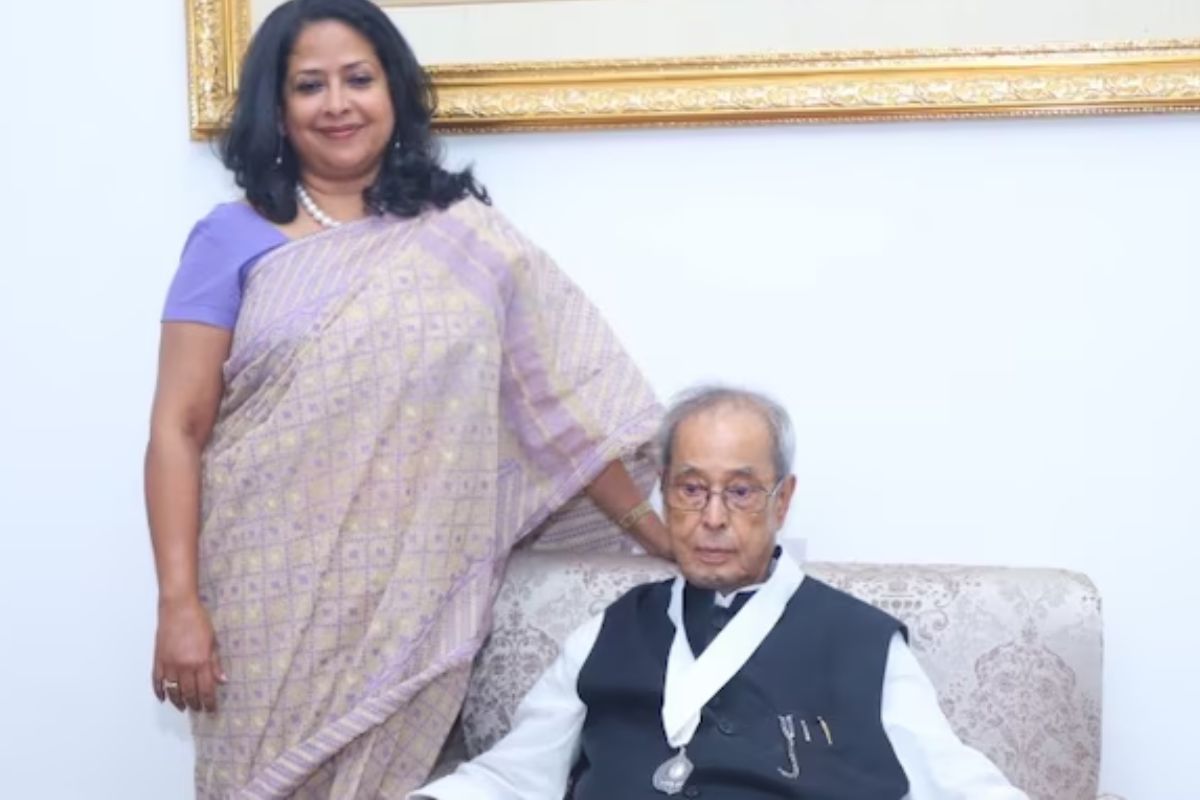
Sharmistha Mukherjee, daughter of former President Pranab Mukherjee, expressed her strong disapproval of the Congress party’s actions in a recent memorial controversy involving the former Prime Minister, Dr. Manmohan Singh. Sharmistha’s criticism focused on the inconsistency of Congress in dealing with the memorialisation of its prominent leaders, particularly in contrast to its demand for a dedicated space for Dr. Singh.
She recalled how, after the passing of her father, the Congress did not convene a Working Committee meeting to express condolences. “Sharmistha Mukherjee,” who had been a member of the Congress party herself, revealed that a senior Congress leader dismissed the notion of a condolence meeting for former Presidents, claiming that such meetings were not customary. This reasoning, she argued, was flawed and contradictory, especially considering historical precedents.
In her statement, Sharmistha highlighted that when former President KR Narayanan passed away, Pranab Mukherjee himself had drafted a condolence message and a CWC meeting was called to mourn the loss. The lack of a similar gesture for her father deeply disturbed her, showing what she described as the party’s selective treatment of its leaders.
Sharmistha Mukherjee’s Take on the Memorial Debate
Despite her frustration with the Congress’s handling of her father’s death, Sharmistha Mukherjee acknowledged that Dr. Manmohan Singh, the former Prime Minister, deserved a memorial. She fully supported the idea of creating a separate space for Dr. Singh, reflecting on his contributions to the nation. Sharmistha also noted that her father, Pranab Mukherjee, had once advocated for Dr. Singh to be awarded the Bharat Ratna, which did not materialize during his presidency. “Manmohan Singh deserves a memorial, and he also deserves the Bharat Ratna,” Sharmistha commented, alluding to political factors that may have prevented such an honor from being conferred.
Her comments came amid a growing controversy surrounding the memorial for Dr. Manmohan Singh. Congress President Mallikarjun Kharge had written to Prime Minister Narendra Modi and Union Home Minister Amit Shah, requesting that a separate memorial space be established for the former Prime Minister. The request was rooted in a tradition of honoring distinguished political leaders with such memorials, but it faced initial rejection from the government, which chose Nigambodh Ghat, a public crematorium, as the location for Dr. Singh’s last rites.
Congress vs BJP: A Political Battle Over Memorials
The BJP seized upon the Congress’s memorial request to highlight what they saw as a pattern of neglect by the Congress in memorializing its own leaders. Congress had failed to build a memorial for former Prime Minister PV Narasimha Rao after his death in 2004, despite the UPA government being in power for a decade. It was only in 2015, under the leadership of Prime Minister Narendra Modi, that a memorial for Rao was established, followed by the posthumous award of the Bharat Ratna in 2024.
BJP spokesperson CR Kesavan sharply criticized Congress for its selective approach. He pointed out that the party had not built a memorial for Rao, and yet now sought a memorial for Dr. Singh, despite the BJP’s earlier recognition of Rao’s contributions. Kesavan’s remarks underscored the accusations of hypocrisy leveled at Congress, which was now demanding special treatment for one leader while having ignored another.
Sharmistha Mukherjee’s Frustration with the Party
The focus of Sharmistha Mukherjee’s remarks was not only the treatment of her late father but also the broader issue of how the Congress party handled the legacies of its leaders. She referred to the inconsistency in their practices, which, according to her, highlighted an internal disarray when it came to honoring the memory of their political figures.
The political discourse surrounding Dr. Manmohan Singh’s memorial raised questions about how political parties manage the legacies of their leaders. Sharmistha’s stance reflected a deeper concern about the Congress party’s internal dynamics and its handling of past and present leaders’ legacies. The timing of her comments further intensified the debate, as the issue of memorials became a focal point for both political rivals and the media.
Sharmistha Mukherjee’s Views and the Current Controversy
In a late-night development, the central government took steps to resolve the impasse, agreeing to provide a separate memorial space for Dr. Manmohan Singh. This move was seen as a sign of compromise amid mounting political pressure, particularly from the Congress, which had been vocal in demanding the creation of a space to honor Dr. Singh’s long and distinguished career in public service.
While the situation remains contentious, the debate over the treatment of memorials for political leaders continues to spark significant public interest. Sharmistha Mukherjee’s outspokenness has brought attention to broader issues within the Congress party, calling into question its internal politics and its approach to commemorating its past leaders. The row over Dr. Manmohan Singh’s memorial has only further complicated the political landscape, leaving many to wonder if this episode will lead to a reevaluation of how political legacies are managed in India.